Is Your Cordless Tool Battery Dead or Just Flat?
Flat, protected or failed: three very different problems that look the same when the tool won't go.
You pull the trigger and nothing happens. The battery might just be flat, it might have switched itself off to protect itself, or it might really be finished. They look the same in the tool, but they mean very different things.
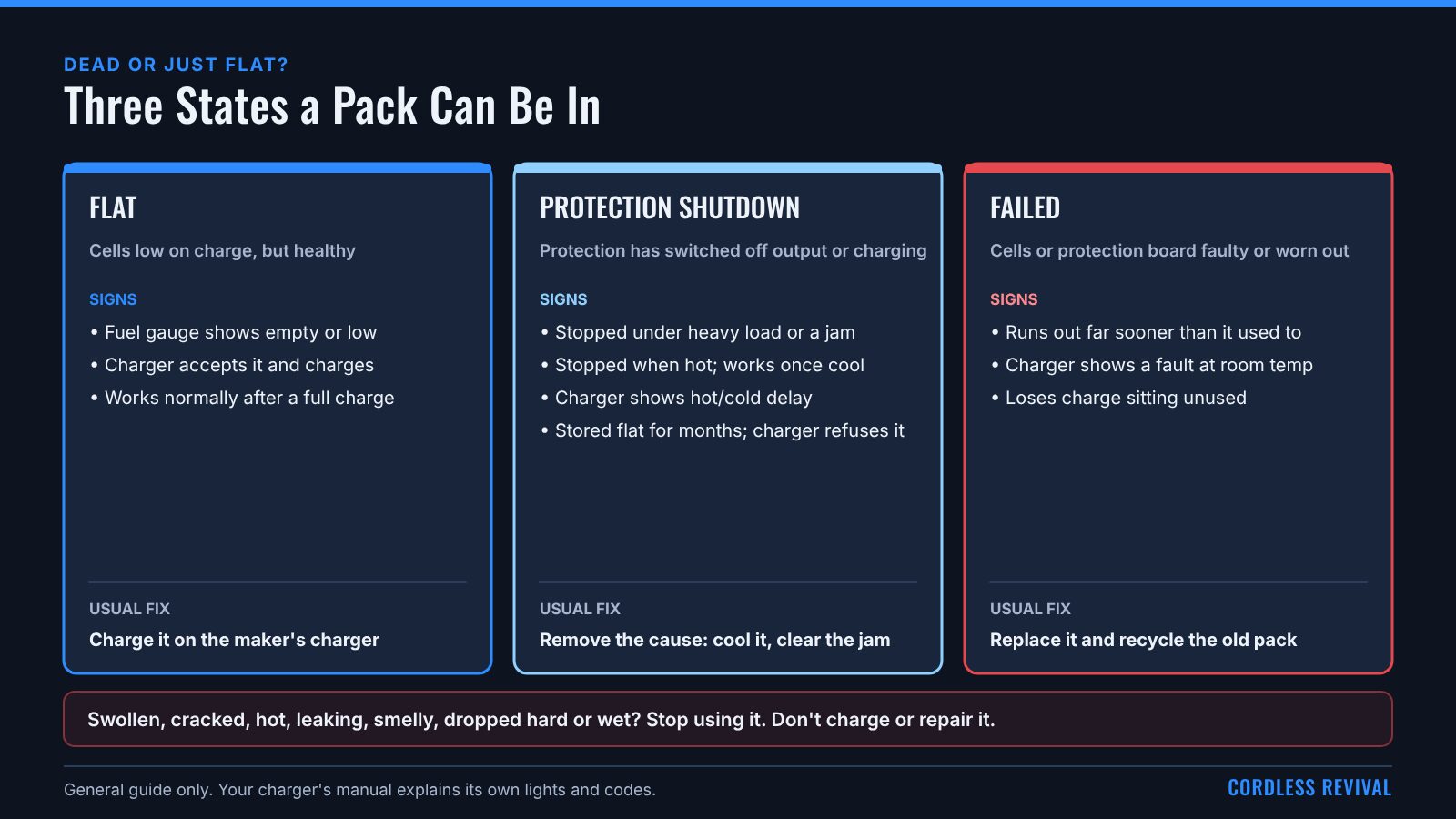
1. The three states
| State | What's happening | What usually fixes it |
|---|---|---|
| Flat | The cells are low on charge, but healthy | Charging it on the maker's charger |
| Protection shutdown | The pack's protection (or the tool's or charger's) has switched off output or charging, for a reason such as heat, a jam, low voltage or a fault | Removing the cause: cooling down, clearing a jam, or a charger that recognises the pack |
| Failed | One or more cells or the protection board is faulty or worn out | Replacement, and recycling the old pack |
1a. Five questions, in order
- Is it swollen, cracked, hot, leaking, smelly, dropped hard or wet? Yes: stop. It's damaged, not flat (see section 4).
- Does the maker's charger accept it at room temperature? Yes: let it charge fully, then try it. If it works normally, it was flat.
- Does the charger show a hot or cold delay? Yes: let the pack reach room temperature and try again. That's protection, not failure.
- Did it stop under heavy load or heat, then work again after a rest? Yes: that's protection. Remove the cause (jam, blunt blade, overheating).
- Does it charge but run out far sooner, cut out under normal load, or show a fault code? Yes: it has likely failed. Check the warranty first.
2. Signs it's just flat
- The fuel gauge shows empty or low.
- The charger accepts it and starts charging normally.
- After a full charge it works normally again.
That's not a fault. The pack was empty.
3. Signs of a protection shutdown
- It stopped suddenly under heavy load, such as a jammed blade or a stalled drill, then works again after you release the trigger or reseat the battery. Many systems cut out on high current to protect the cells and motor.
- It stopped when it got hot, and works again after cooling down.
- The charger shows a hot or cold delay. It's waiting for the pack to reach a safe charging temperature.
- It was stored flat for a long time, and now the charger won't take it. The pack may have dropped below the charger's minimum voltage, and the charger refuses it on purpose. Deeply discharged lithium cells can be damaged and unsafe to recharge.
See Charger Flashing Lights and the BMS for what your charger's lights usually mean.
4. Signs it's failed
- It charges to full but runs out far sooner than it used to, or cuts out under normal load.
- The charger flashes a fault or "defective pack" code, even with the pack at room temperature and clean contacts.
- It drops charge quickly while sitting unused.
- It's swollen, cracked, hot, leaking, smells or has been dropped hard or got wet. That's not just "failed". Stop using it and see When Should a Battery Pack Not Be Repaired?.
5. Why a voltage reading alone can't decide it
A multimeter across the pack's terminals is a useful clue, but it can't settle the question on its own:
- A failed pack can still read a normal voltage with nothing connected, then collapse under load.
- Some packs show little or no voltage at the terminals until they're in a tool or charger, even when they're fine.
- The reading is all the cells added together, so one weak cell can hide behind the others.
Use the reading as one clue among several. See How to Test a Cordless Pack With a Multimeter. Revival Academy 101 explains what voltage readings can and can't tell you.
6. What to do next
- Charge it on the maker's charger at room temperature. If it charges and works, it was flat.
- If the charger won't take it, work through Why Won't My Cordless Battery Charge?: the charger, temperature, contacts and pack voltage, in that order.
- If it still won't work, check the warranty first. Opening a pack usually voids it.
- Out of warranty? See Is a Battery Pack Rebuild Worth It? and the Rebuild or Replace Calculator.
Don't try to "kick start" a pack the charger has refused, using another battery or a power supply. Damaged cells can overheat or catch fire during charging, sometimes later.
6a. Three worked cases (made-up examples)
Case A: the mower pack that won't charge.
- What happened: after mowing on a hot afternoon, the pack goes straight on the charger and a light flashes.
- What the manual says: that light pattern means hot delay.
- The outcome: half an hour in the shade later, it charges normally. Protected, not failed.
Case B: the drill pack stored over winter.
- What happened: a pack left flat in the shed since autumn. The charger won't take it.
- The readings: a multimeter shows it well below its usual flat reading.
- The outcome: the pack has likely dropped below the charger's minimum, and the charger is refusing it on purpose. Don't try to force it.
- What to do next: check the warranty, then see Why Won't My Cordless Battery Charge?.
Case C: the saw pack that cuts out.
- What happened: the pack reads a healthy voltage on the bench and runs a torch happily, but the circular saw cuts out in hardwood after a few cuts.
- The cross-check: in another saw of the same platform, it does the same.
- The outcome: the pack can't deliver high current any more, typical of ageing cells. Failed for heavy work. It may still suit a light tool.
6b. Before you buy a replacement
- Read the model number on the old pack, tool and charger. See How to Read a Cordless Battery Label.
- Check the maker's compatibility list for the replacement and your charger.
- Consider a high-output pack if the old one struggled in hungry tools.
- Buy genuine from a reputable seller. Cheap no-name packs often overstate their capacity.
- Recycle the old pack properly. Tape the terminals and use a battery drop-off point.
6c. Stopping it happening again
- Don't store packs flat. Store them partly charged and check them every few months.
- Let hot packs cool before charging.
- Keep packs out of hot vehicles and direct sun.
- Use a pack that suits the tool.
See Why Cordless Tool Batteries Lose Capacity and Lithium Battery Storage and Disposal.
7. Quick summary
- Flat: charges and works. Not a fault.
- Protected: stops for a reason (heat, jam, very low voltage) and the cause needs removing.
- Failed: charges but won't perform, shows a fault code, or loses charge fast. Replace and recycle.
- Damaged: swollen, hot, leaking, dropped or wet. Stop using it.
8. Common mistakes
- Binning a pack that was just in hot delay.
- Forcing a refused pack to charge with another battery or a power supply.
- Deciding from one voltage reading.
- Opening a pack under warranty.
- Buying a replacement by voltage and Ah alone, without the model number.
9. Frequently asked questions
My charger flashes red and green. Is the battery dead?
Not necessarily. Many chargers use flashing patterns for hot or cold delay as well as faults. Check the charger's manual. See Charger Flashing Lights and the BMS.
Can a deeply flat lithium pack be saved?
Sometimes the maker's charger will recover it, and sometimes it refuses it on purpose. Deeply discharged cells can be damaged. Don't force a charge. Check the warranty and the maker's advice.
Why does my pack work in the drill but not the saw?
High-draw tools need more current. An ageing pack may still run light tools but cut out in hungry ones.
How long should I wait for a hot pack to cool?
Until it's at room temperature. The charger's light usually changes when it's ready.
Is it worth fixing a failed pack?
Check the warranty first. Then see Is a Battery Pack Rebuild Worth It? and the Rebuild or Replace Calculator. Cordless Revival doesn't repair packs.
Safety: this guide is general information. Follow your tool and battery maker's instructions. Cordless Revival doesn't repair, test or sell batteries.
Related guides

Charger Flashing Lights and the BMS
What a flashing charger is usually telling you, and what the battery management board does inside the pack.
Read guide →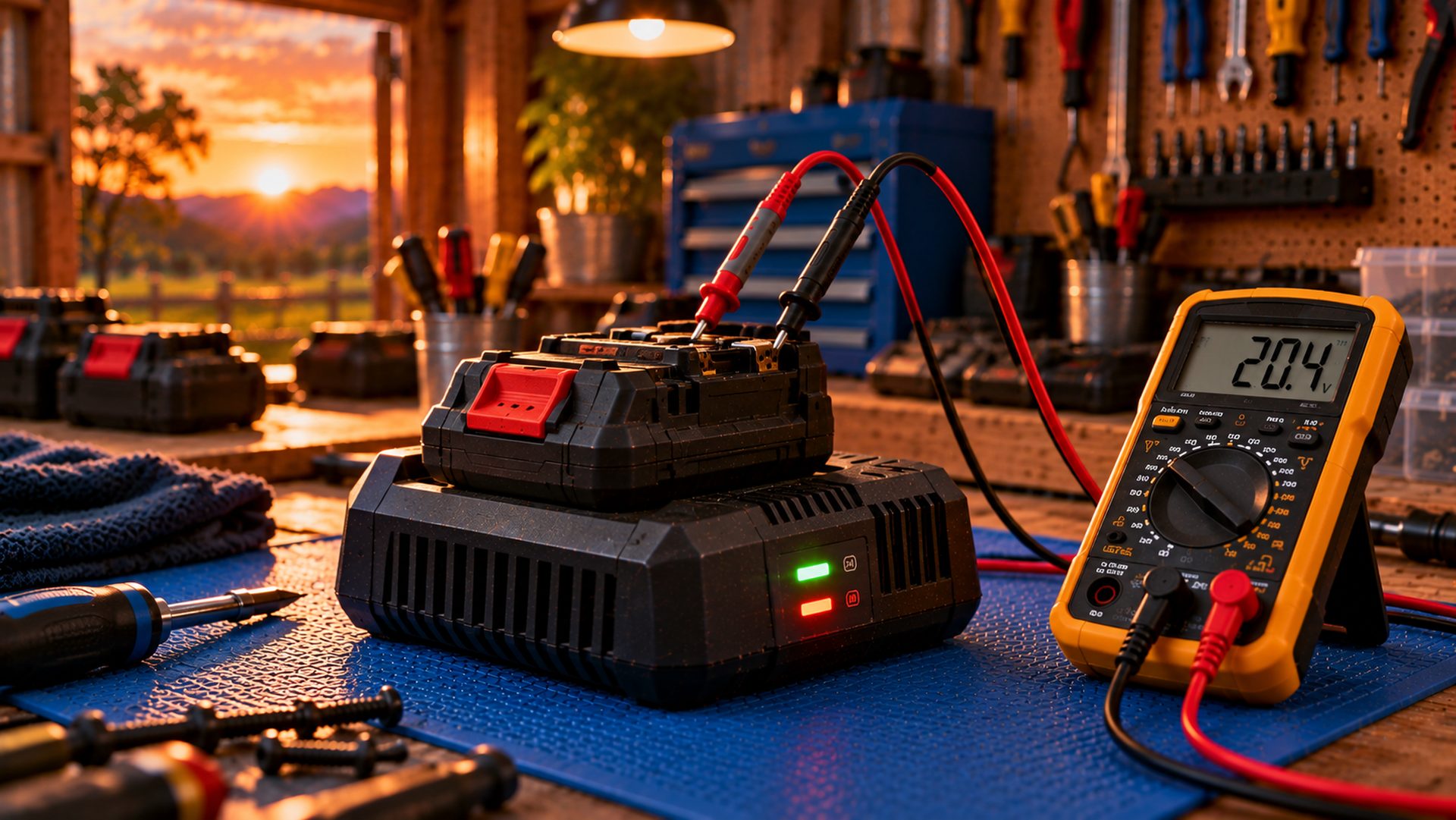
Why Won't My Cordless Battery Charge?
A step-by-step check of the charger, the contacts and the pack voltage, so you know where the fault really is.
Read guide →