When Should a Battery Pack Not Be Repaired?
The warning signs that mean a lithium-ion pack is finished, and what to do with it safely.
Some battery faults are worth investigating. A pack that won't charge might have dirty contacts, a charger problem or a protection board that has switched off. Other packs are past saving, and trying to repair them is where people get hurt.
This guide covers the signs that mean a pack should be retired, not repaired. It applies to cordless tool packs, and also to e-bike and e-scooter batteries, which hold much more energy.
1. Why some packs shouldn't be repaired
Lithium-ion cells store a lot of energy in a small space. A healthy cell keeps that energy under control. A damaged cell may not. It can heat itself up, vent flammable gas and catch fire. This is called thermal runaway, and once it starts, it is very hard to stop.
Damage inside a cell can't be seen or fixed from outside. New cells, a new case or a new protection board don't make a damaged pack safe. The pack is finished if it shows any of the signs below.
2. The warning signs: stop, don't repair
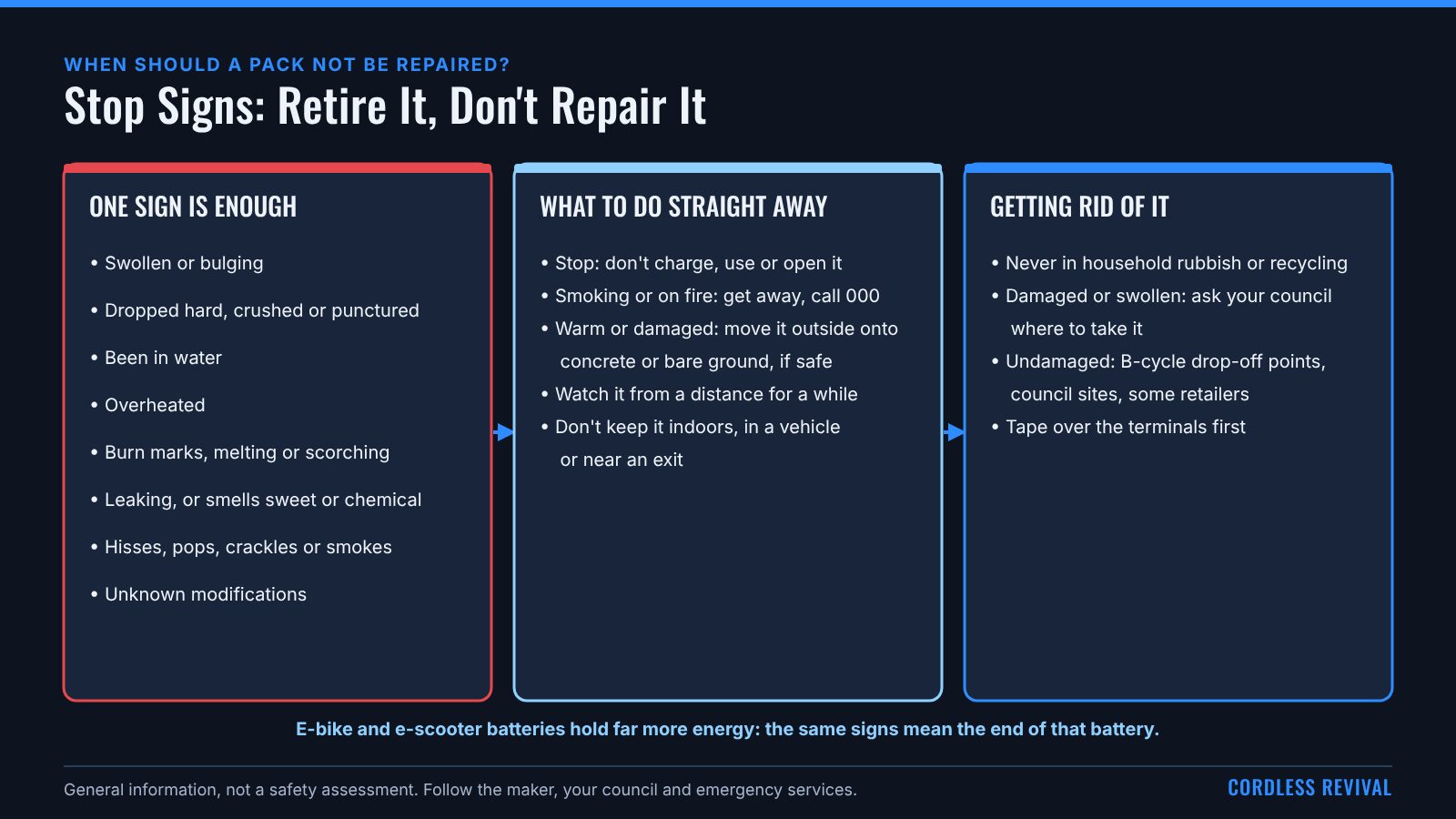
Stop using, charging or opening the pack if it:
- Is swollen or bulging. The case may crack, split or no longer sit flat in the tool or charger. Swelling usually means gas has built up inside the cells.
- Has been dropped hard, crushed or punctured. Impact can damage the inside of a cell even when the case looks fine.
- Has been in water, including a flood, rain inside the case or being left in a puddle.
- Has overheated, or got unusually hot on the charger or in use.
- Shows burn marks, melting, scorching or discolouration on the case, the terminals or the charger.
- Is leaking, or smells sweet or chemical.
- Hisses, pops, crackles or smokes.
- Has unknown modifications. Examples include a second-hand pack that has been opened before, cells of unknown origin, a bypassed protection board, or home-made wiring.
- Loses charge very fast, or won't hold a charge after a known fault like a short circuit or a crash.
One sign is enough. You don't need to see several.
3. What to do straight away
- Stop. Don't charge it, don't put it back in the tool and don't open it.
- If it's hot, smoking or on fire: get everyone away from it and call 000. Don't try to carry a burning battery.
- If it's warm or damaged but not smoking: move it outside, away from anything that can burn, only if you can do that safely. Put it on a non-flammable surface like concrete or bare ground.
- Watch it from a distance for a while. A damaged pack can heat up some time after the damage was done.
- Don't store it indoors, in a vehicle or near an exit while you work out what to do.
4. Getting rid of it properly
- Never put a lithium battery in your household rubbish or recycling bin. Batteries cause fires in bins, trucks and recycling centres.
- Take damaged or swollen packs to the right place. They may need special handling, so ask your local council where to take them. Your state's environment agency or fire service may also have guidance.
- For packs that aren't damaged, Australia's B-cycle scheme lists battery drop-off points on its website, and many council sites and some retailers accept batteries.
- Tape over the terminals with clear sticky tape before you drop off a pack.
Our Lithium Battery Storage and Disposal guide has more on storing packs and dropping them off.
5. When a pack might still be worth looking at
Not every dead pack is dangerous. These problems are often worth checking before you give up on a pack, as long as none of the warning signs above apply:
- The charger flashes an error, but the pack looks and feels normal. See Charger Flashing Lights and the BMS.
- The pack won't charge, but it was stored for a long time and isn't damaged. See Why Won't My Cordless Battery Charge?.
- The pack runs for less time than it used to. That's normal ageing, not a hazard.
- The contacts are dirty or worn.
Even then, there's no rule that you must repair it. If you're unsure, a genuine replacement pack is the safe choice. Our Is a Battery Pack Rebuild Worth It? guide and the Rebuild or Replace Calculator help you weigh it up.
6. E-bike and e-scooter batteries
E-bike and e-scooter batteries work at higher voltages and hold far more energy than tool packs. A damaged one can cause a large, fast-spreading fire.
- The same warning signs apply. Treat any one of them as the end of that battery.
- Don't charge a damaged e-bike or scooter battery, and don't charge any of them in a hallway or near your way out.
- Only use the maker's charger, or one the maker approves.
- Opening an e-bike or scooter battery isn't a home job. Talk to the maker or the retailer.
See Charging E-Bikes Safely at Home and E-Scooter Battery Care and Charging.
7. Common mistakes
- "It's only a little bit swollen." Any swelling means the pack is finished.
- Pressing a swollen pack flat to make it fit the tool. This can damage the cells further.
- Testing a damaged pack "just once more" on the charger.
- Buying second-hand packs that have been opened, or packs with unknown history.
- Putting a pack in the bin because it "looks fine now".
- Trusting a pack that got wet once it has dried out. Water can leave corrosion inside that you can't see.
8. Quick summary
- Swollen, crushed, wet, burnt, leaking, overheated or modified packs are finished. Don't repair them.
- Stop, move it somewhere safe if you can do it safely, and call 000 if it's smoking or on fire.
- Never bin a lithium battery. Ask your council where to take damaged ones.
- Packs with no warning signs may be worth checking for charger, contact or storage faults.
- When in doubt, retire it and buy a genuine replacement.
Safety: this guide is general information, not a safety assessment of your battery. Follow the maker's instructions, your local council's advice and emergency services' directions. Cordless Revival doesn't repair, assess or collect batteries.
Related guides
Lithium Battery Storage and Disposal
How to store tool batteries safely, the warning signs to never ignore, and how to dispose of them properly in Australia.
Read guide →
Charger Flashing Lights and the BMS
What a flashing charger is usually telling you, and what the battery management board does inside the pack.
Read guide →