How to Read a Cordless Battery Label
Nominal vs max voltage, amp-hours, watt-hours and model numbers, explained in plain English.
The label on a cordless tool battery tells you most of what you need to know: which tools it fits, how much energy it holds and how to handle it safely. But the numbers can be confusing. Two brands use different voltages for what is really the same kind of pack, some packs carry two voltages at once, and cheap fakes print numbers that can't be true.
This guide walks through every part of a typical label, then gives you four practice labels to decode. The packs and labels in the examples are made up. They're not real products.
1. Where to find the label
- Most packs have a printed label on the side, back or underneath.
- Some details are moulded into the plastic or printed inside the battery slot, where they only show when the pack is out of the tool.
- The charger has its own label, usually underneath (see section 8).
2. Label anatomy
| Item on the label | What it tells you | Why it matters |
|---|---|---|
| Voltage ("18V", "20V Max") | How many cells are in series, and which figure the maker prints | Platform match; energy sums |
| Capacity ("5.0Ah", "2000mAh") | How much charge it holds | Runtime and weight |
| Energy ("90Wh") | Voltage and capacity combined | The fairest comparison; travel and shipping rules |
| Model or part number | Exactly which pack it is | Compatibility, chargers, replacements, recalls |
| Platform or series name | The family of tools it fits | Fit |
| Serial number or date code | This individual pack | Warranty and recalls |
| Chemistry ("Li-ion") | Cell type | Charging and disposal |
| Warnings and symbols | Handling, charging, disposal | Safety |
3. Voltage: nominal vs max
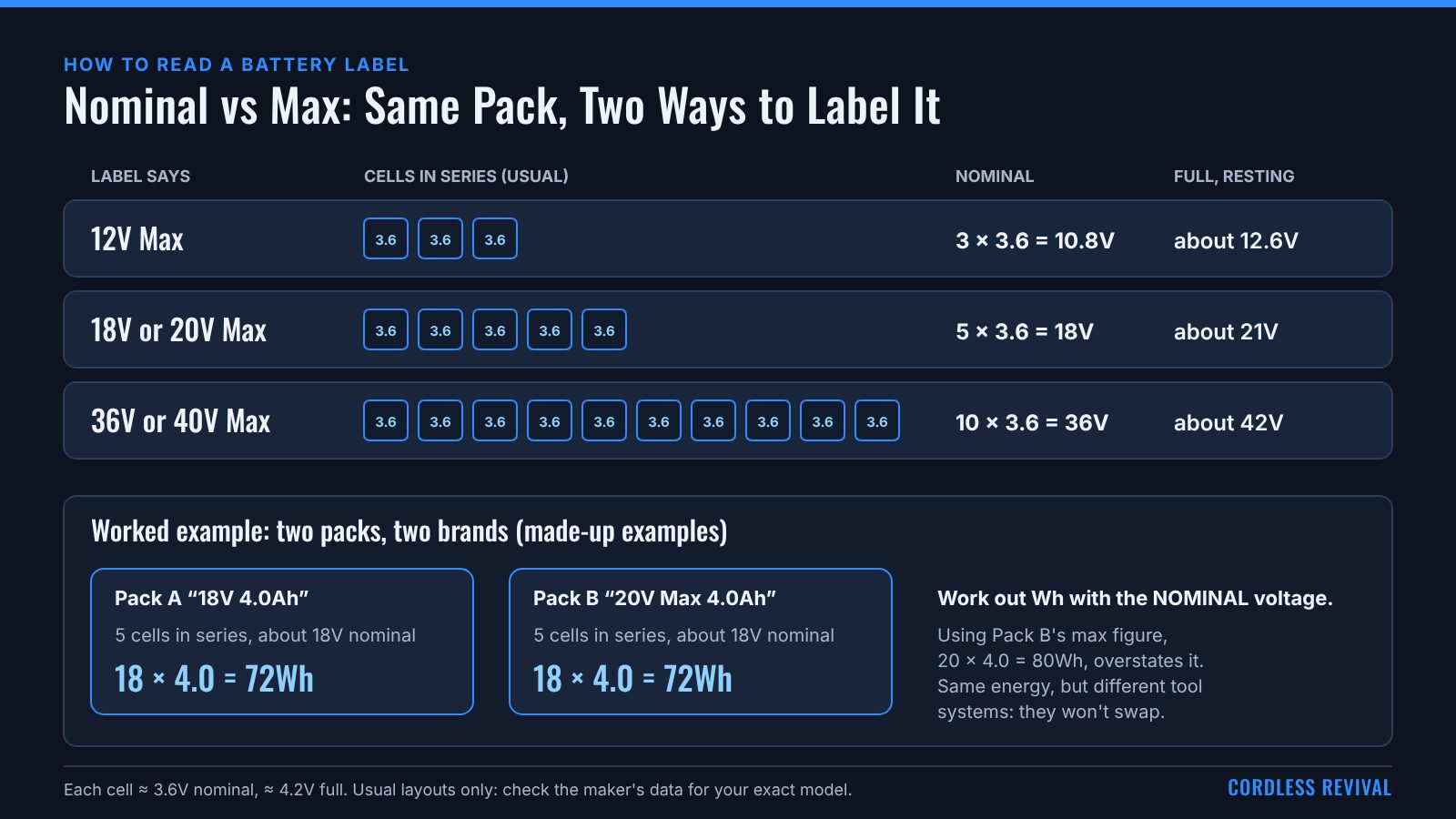
Most tool packs are built from lithium-ion cells joined in series. Each cell is about 3.6V nominal (its average working voltage) and about 4.2V when fully charged. So the pack's voltage depends on how many cells are in series, and on which of those two figures the maker prints.
| Label says | Cells in series (usual) | Nominal voltage | Fully charged, resting |
|---|---|---|---|
| 12V Max | 3 | 3 × 3.6 = 10.8V | About 12.6V |
| 18V or 20V Max | 5 | 5 × 3.6 = 18V | About 21V |
| 36V or 40V Max | 10 | 10 × 3.6 = 36V | About 42V |
| 54V or 60V Max | 15 | 15 × 3.6 = 54V | About 63V |
- Nominal voltage is the average while the pack works. Many brands print this figure, such as "18V".
- Max voltage is the figure with no load, straight off the charger. Brands that print "20V Max" use it.
- So an "18V" pack and a "20V Max" pack are usually the same kind of pack, with 5 cells in series, just labelled differently.
- Some makers rate their cells at 3.7V, so a 5-cell pack may be labelled 18.5V. It's the same idea.
That doesn't make them interchangeable. Different brands use different shapes, terminals and electronics. See Battery Adapters Between Brands.
Don't mix nominal and max voltage when you compare packs. Compare 18V with 18V, or "20V Max" with "20V Max".
Dual-voltage packs
Some brands sell packs that work in two of their platforms. The label then shows two voltages and two capacities, such as "60V Max / 20V Max, 3.0Ah / 9.0Ah" (a made-up example). Inside, the pack's cell groups are connected differently depending on which tool it's in. The energy is the same either way:
- 54V nominal × 3.0Ah = 162Wh.
- 18V nominal × 9.0Ah = 162Wh.
Only use a dual-voltage pack in the tools and chargers its maker lists.
4. Capacity: amp-hours (Ah)
Amp-hours tell you how much charge the pack holds. A 5.0Ah pack holds two and a half times as much as a 2.0Ah pack of the same voltage, so it runs a tool for longer.
- Higher Ah usually means a bigger, heavier pack, because it has more cells or larger cells.
- Small packs sometimes show capacity in milliamp-hours: 1,000mAh = 1Ah.
- Capacity is measured under test conditions. Heavy use and cold weather give less.
The 18650 vs 21700 Cells Explained guide shows how cell size and cells in parallel set capacity, and the Cell Layout Calculator works out a layout.
5. Energy: watt-hours (Wh)
Watt-hours are the best way to compare packs, because they include both voltage and capacity:
Watt-hours = nominal voltage × amp-hours
| 18V nominal pack | Energy |
|---|---|
| 1.5Ah | 27Wh |
| 2.0Ah | 36Wh |
| 3.0Ah | 54Wh |
| 4.0Ah | 72Wh |
| 5.0Ah | 90Wh |
| 6.0Ah | 108Wh |
| 8.0Ah | 144Wh |
| 12.0Ah | 216Wh |
A 36V 2.5Ah pack also holds 36 × 2.5 = 90Wh, the same as an 18V 5.0Ah pack.
Many labels print the Wh figure. If yours doesn't, work it out with the nominal voltage. The mAh, Ah and Wh Converter at Revival Academy 101 does it for you.
Travel and posting: airlines and freight services limit lithium batteries by their Wh rating. Check their current rules before you fly or post a pack.
6. A rough runtime estimate
Runtime (hours) ≈ pack Wh ÷ the tool's average watts
Example (made-up figures): a 90Wh pack in a tool averaging 300W lasts roughly 90 ÷ 300 = 0.3 hours, or about 18 minutes of actual running.
Treat it as a rough guide only. Tools draw very different power depending on the job, losses aren't counted, and packs deliver less when hot, cold or worked hard. Cordless Revival's Pack Runtime Calculator and Cuts per Charge Calculator give better estimates for real tools.
7. Model number, platform and other codes
- Model or part number: the most important code on the label. It identifies the exact pack, which tools and chargers suit it, and which replacement to buy. Use it, not just the voltage and Ah, when you check compatibility. See Will This Battery Fit My Tool?.
- Platform or series name: the family of tools the pack fits. A brand can have more than one platform at the same voltage.
- Performance labels: some brands mark high-output or compact versions. These can matter for high-draw tools, so check the maker's guidance.
- Serial number or date code: identifies the individual pack. It's useful for warranty claims and recalls, so photograph it when you buy.
8. The charger label
The charger has its own label, usually underneath:
- Input: for example "220–240V AC 50/60Hz", or whatever range it's built for. In Australia, mains is 240V AC.
- Output: the charging voltage and current, such as "18V DC 3A" (made-up example).
- Compatible batteries: the platform or a list of model numbers. A charger can physically take a pack it isn't designed for, so check the list.
- Warnings: indoor use only, temperature range, and "use only with" statements.
Charging time depends on the pack's Ah and the charger's current, and on the pack's temperature. The Pack Charge Time Calculator estimates it.
9. Warnings and symbols
Labels usually carry:
- Safety warnings: don't short the terminals, don't expose to heat or fire, don't get wet, and only use the maker's charger.
- A crossed-out wheelie bin: don't put the pack in household rubbish. See Lithium Battery Storage and Disposal.
- Recycling and compliance marks: these vary by maker and country.
- Temperature limits: for use, charging or storage, on some packs.
Read the warnings on your own pack and in its manual. They're specific to that pack.
10. Label worn off, or a counterfeit?
If the label is worn off:
- Look for moulded numbers on the case and inside the battery slot.
- Check the tool and charger manuals for the compatible model list.
- Search the maker's website using the platform name and photos of the pack's shape.
- Don't open the pack to read the cells. It voids the warranty and handling lithium cells needs the right expertise.
Red flags on a cheap or no-name pack:
| Red flag | Why |
|---|---|
| Capacity far above the brand's own range, such as "12,000mAh" in a pack the size of a 2Ah genuine pack | Physically unlikely for that size |
| Wh figure that doesn't match V × Ah | Careless or false labelling |
| No model number, no maker's name, no compliance marks | Can't be checked or traced |
| Much lighter than the genuine pack of the same claimed Ah | Fewer or smaller cells than claimed |
| Spelling mistakes and blurry printing | A common sign of a counterfeit |
| Price far below genuine | Usually a reason, often the cells or protection |
Counterfeit packs and cells often claim far more capacity than they have, and they may lack proper protection. When in doubt, buy genuine from a reputable seller.
11. Practice: decode these labels
These labels are made up for practice. Cover the answers and try them first.
| Label | Questions |
|---|---|
| A: "12V Max 3.0Ah" | Cells in series? Nominal voltage? Wh? |
| B: "60V Max / 20V Max, 3.0Ah / 9.0Ah" | Energy in each mode? |
| C: "18V 5.0Ah 90Wh" | Is the Wh figure consistent? |
| D: "18V 12000mAh", in a case the size of a genuine 2Ah pack, with no model number | What do you conclude? |
Answers:
- A: 3 cells; 3 × 3.6 = 10.8V nominal; 10.8 × 3.0 ≈ 32Wh. Using 12V would overstate it.
- B: 54 × 3.0 = 162Wh, and 18 × 9.0 = 162Wh. The same energy in both modes.
- C: 18 × 5.0 = 90Wh. Consistent.
- D: 12,000mAh = 12Ah, and 18 × 12 = 216Wh claimed. That's six times a genuine 2Ah pack of the same size, with no model number. Treat it as a counterfeit: don't buy it, and don't rely on it.
12. Frequently asked questions
Is a 20V Max battery more powerful than an 18V one?
Usually not. Most are the same 5-cell pack, labelled with a different figure. Compare their Wh using the nominal voltage.
Can I use a higher-Ah battery in my tool?
Often yes, within the same platform, if it's on the maker's compatibility list. Bigger packs can be heavier and taller, and some tools or chargers have limits.
How do I work out watt-hours if the label doesn't show them?
Nominal voltage × Ah. For a "20V Max" pack, use 18V.
What does the date code tell me?
When the pack was made, in the maker's own format. It's useful for warranty and recalls, and for spotting old stock.
My label has worn off. How do I find the model?
Check for moulded numbers, the battery slot and the tool and charger manuals, then search the maker's website. Don't open the pack.
13. Common mistakes
- Thinking "20V Max" beats "18V" because the number is bigger.
- Working out Wh from the max voltage.
- Buying by voltage and Ah alone without checking the model number.
- Assuming a bigger pack fits every tool and charger.
- Trusting impossible numbers on no-name packs.
14. Quick summary
- Nominal is the average working voltage; max is the full-charge figure. "18V" and "20V Max" are usually the same kind of pack.
- Ah is capacity. Wh = nominal V × Ah, and it's the fairest comparison.
- Dual-voltage packs show two ratings with the same energy.
- The model number is the key to compatibility, chargers and replacements.
- Read the warnings, check the charger's label, and walk away from impossible numbers.
Safety: don't open a pack to read the cells inside. If a pack is swollen, damaged, hot or leaking, stop using it. See When Should a Battery Pack Not Be Repaired?. Cordless Revival doesn't repair, assess or sell batteries.
Related guides
Battery Adapters Between Brands: Are They Safe?
How brand-to-brand battery adapters work, what can go wrong, and what to check before you use one.
Read guide →
Lithium Battery Storage and Disposal
How to store tool batteries safely, the warning signs to never ignore, and how to dispose of them properly in Australia.
Read guide →