Cordless Battery Compatibility: Will This Battery Fit My Tool?
Five checks before you buy a battery, so it fits, works and charges safely.
"It's the same brand and the same voltage, so it'll fit." Often true, sometimes not. Brands change their battery platforms over the years, and a battery that slides into the tool may still not suit it, or its charger. Here's how to check before you spend money.
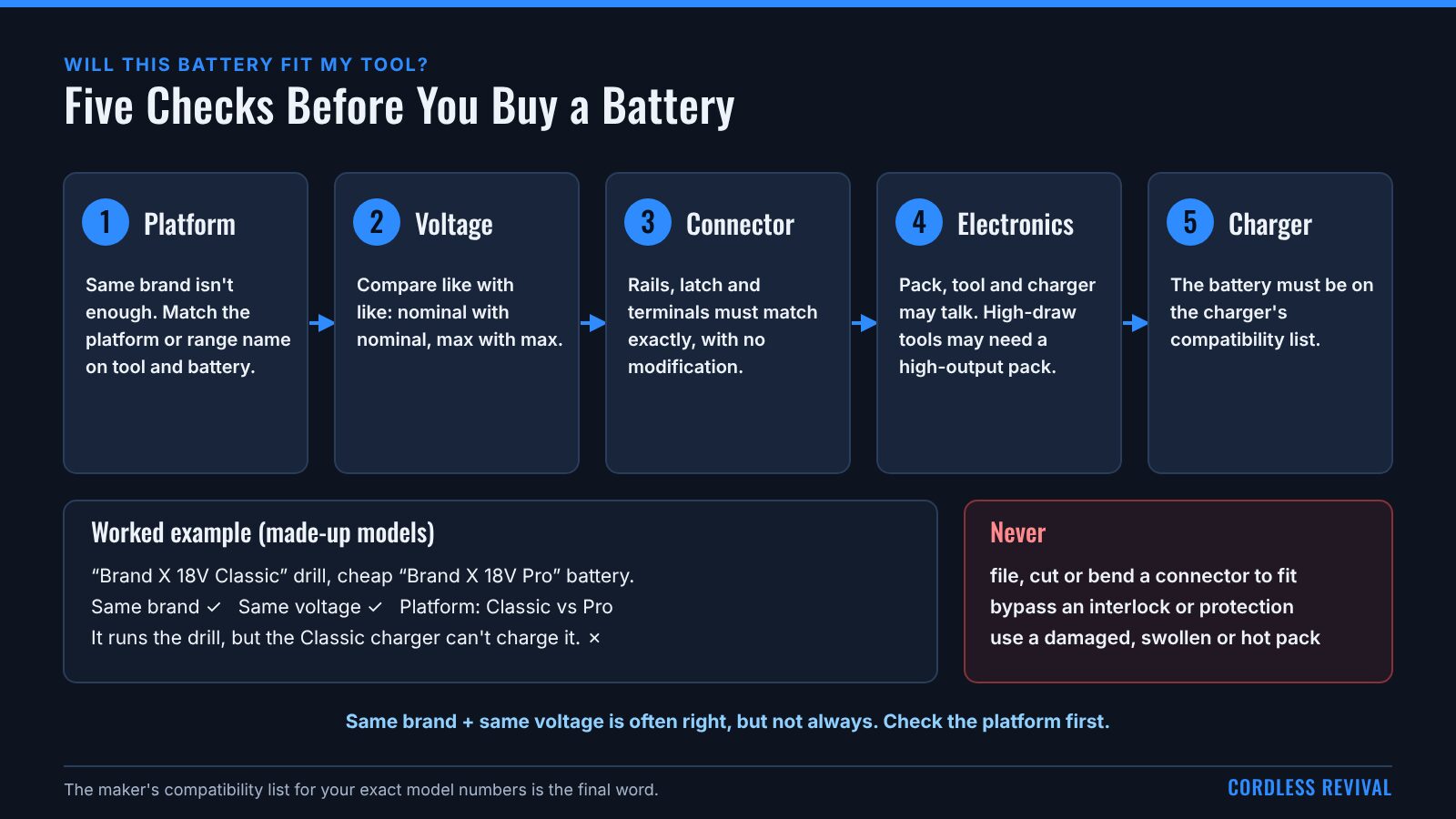
Check 1: Platform, not just brand
Most brands sell their tools in battery platforms (also called systems or ranges). Batteries are designed to work across one platform.
- A brand may have more than one platform at the same voltage, such as an older and a newer range, or a compact and a full-size range, that don't share batteries.
- A brand may have platforms at different voltages that look similar but don't interchange.
- Some brands have multi-voltage batteries designed to work in two of their platforms.
Find the platform name on the tool and the battery, and check they match.
Check 2: Voltage, compared like with like
The voltage must match the platform. Compare nominal with nominal or max with max. An "18V" pack and a "20V Max" pack are usually the same kind of pack labelled differently, but they're different brands' platforms. See How to Read a Cordless Battery Label.
Check 3: The connector and shape
- The battery's rails, latch and terminals must match the tool's battery mount exactly.
- Never file, cut, bend or modify a connector or mount to make a battery fit. A poor fit can cause arcing, heat and damaged terminals, and it can stop the safety features working.
- Bigger, higher-capacity packs can be taller or heavier. They may not fit some compact tools, chargers or tool cases, or may unbalance a tool. The maker's list says which combinations it supports.
Check 4: The electronics
Many modern packs and tools talk to each other. Depending on the brand, the pack, tool and charger may share temperature, current limits, low-voltage cut-off or a pack ID.
- An older tool may not use a newer pack's features, but still work.
- A newer high-draw tool may need a high-output pack, and may run poorly, or not at all, on an older or smaller pack.
- Some protection is in the tool or charger rather than the pack. That's why brand-to-brand adapters can lose protection. See Battery Adapters Between Brands.
Never defeat or bypass an interlock, sensor or protection circuit to make a battery work.
Check 5: The charger
- The battery must be on the charger's compatibility list. A charger may physically take a pack and still not be designed for it.
- Fast chargers may need a pack that supports fast charging.
- Only charge a battery on its own brand's charger for that platform.
Where to find the answer
- The maker's compatibility list or chart, on its website or in the manual. This is the final word.
- The model numbers on the tool, battery and charger. Search those, not just the voltage.
- The retailer, if it's a reputable one, but check its answer against the maker's list.
Worked example (made-up models)
You own a "Brand X 18V Classic" drill and see a cheap "Brand X 18V Pro" battery.
- Same brand: ✓
- Same voltage: ✓
- Platform: Classic vs Pro. The maker's list shows Pro batteries fit Classic tools, but Classic chargers can't charge Pro batteries. ✗ for your charger.
The answer: the battery would run the drill, but you'd need a new charger too. That changes the price.
More worked examples (made-up models)
Example 2: a bigger pack in a compact tool.
- The plan: you want to use a "Brand X 18V Pro 8.0Ah" pack in your "Brand X 18V Pro compact" impact driver.
- The checks: the platform matches and the voltage matches. The maker's list shows the pack fits.
- The catch: it's tall and heavy, so the driver becomes awkward overhead. It fits, but a smaller pack suits that tool better.
Example 3: a dual-voltage pack.
- The pack: a "Brand Y 60V Max / 20V Max" pack.
- What the maker's list says: it runs both the Brand Y 60V Max saw and the 20V Max drill. It must be charged on the dual-voltage charger, not the older 20V-only charger.
- The lesson: check the charger as well as the tool.
Finding the maker's compatibility list
- Read the model numbers on the tool, the battery and the charger. See How to Read a Cordless Battery Label.
- Go to the maker's own website. Look for "battery compatibility", "system" or the platform name.
- Check the tool's manual. It usually lists the batteries and chargers it's designed for.
- Check the battery's and the charger's manuals too. Compatibility has to work both ways.
- Keep a screenshot or note with the date. Makers update their lists.
Second-hand and "compatible" packs
- Second-hand genuine packs:
- Check for damage, swelling and signs of having been opened.
- Check the model number against the list.
- Ask about the pack's age and how it was stored.
- A cheap old pack may already have lost much of its capacity.
- Third-party "compatible" packs:
- They may fit, but the protection, the communication with the tool and charger, and the quality vary.
- Some brands void the tool's warranty if non-genuine packs are used.
- Overstated capacity is common.
- Opened or rebuilt packs: see Is a Battery Pack Rebuild Worth It?. Unknown modifications are a reason not to use a pack (see When Should a Battery Pack Not Be Repaired?).
Fit check (fill in)
| Check | Tool | Battery | Charger | Match? |
|---|---|---|---|---|
| Brand | ||||
| Platform or system name | ||||
| Voltage (same basis: nominal or max) | ||||
| Model number | ||||
| On the maker's compatibility list? | ||||
| Physical fit without modification | ||||
| Size and weight suit the tool |
Frequently asked questions
Will an 18V battery fit my 20V Max tool?
Only if both are from the same brand and platform. Across brands, the shapes and electronics differ even when the voltages describe the same kind of pack.
Can I use a bigger Ah battery in my tool?
Usually yes, within the same platform, if it's on the maker's list. It will run longer but may be heavier and taller.
Will my old charger charge a new battery?
Not always. Check the charger's compatibility list. Newer or dual-voltage packs may need a newer charger.
Are "compatible" batteries safe?
Quality varies a lot. Protection and communication with the tool and charger may differ from genuine packs, and they may affect your warranty. Genuine packs from reputable sellers are the safest choice.
Can I use an adapter to run another brand's battery?
Some people do, with trade-offs in protection and warranty. See Battery Adapters Between Brands.
Common mistakes
- Matching brand and voltage only and skipping the platform.
- Forcing a fit, or modifying the connector or latch.
- Using a no-name "compatible" battery without checking its protection and the warranty.
- Assuming the old charger will charge the new battery.
- Ignoring the warranty: some brands void tool warranties if non-genuine batteries are used.
Quick summary
- Match the platform, not just the brand and voltage.
- The connector must fit without modification.
- Check the electronics and the charger compatibility too.
- The maker's compatibility list is the final word.
Safety: never modify connectors or defeat safety or interlock systems. If a pack is damaged, swollen or hot, stop using it. Cordless Revival doesn't sell batteries or test compatibility.
Related guides
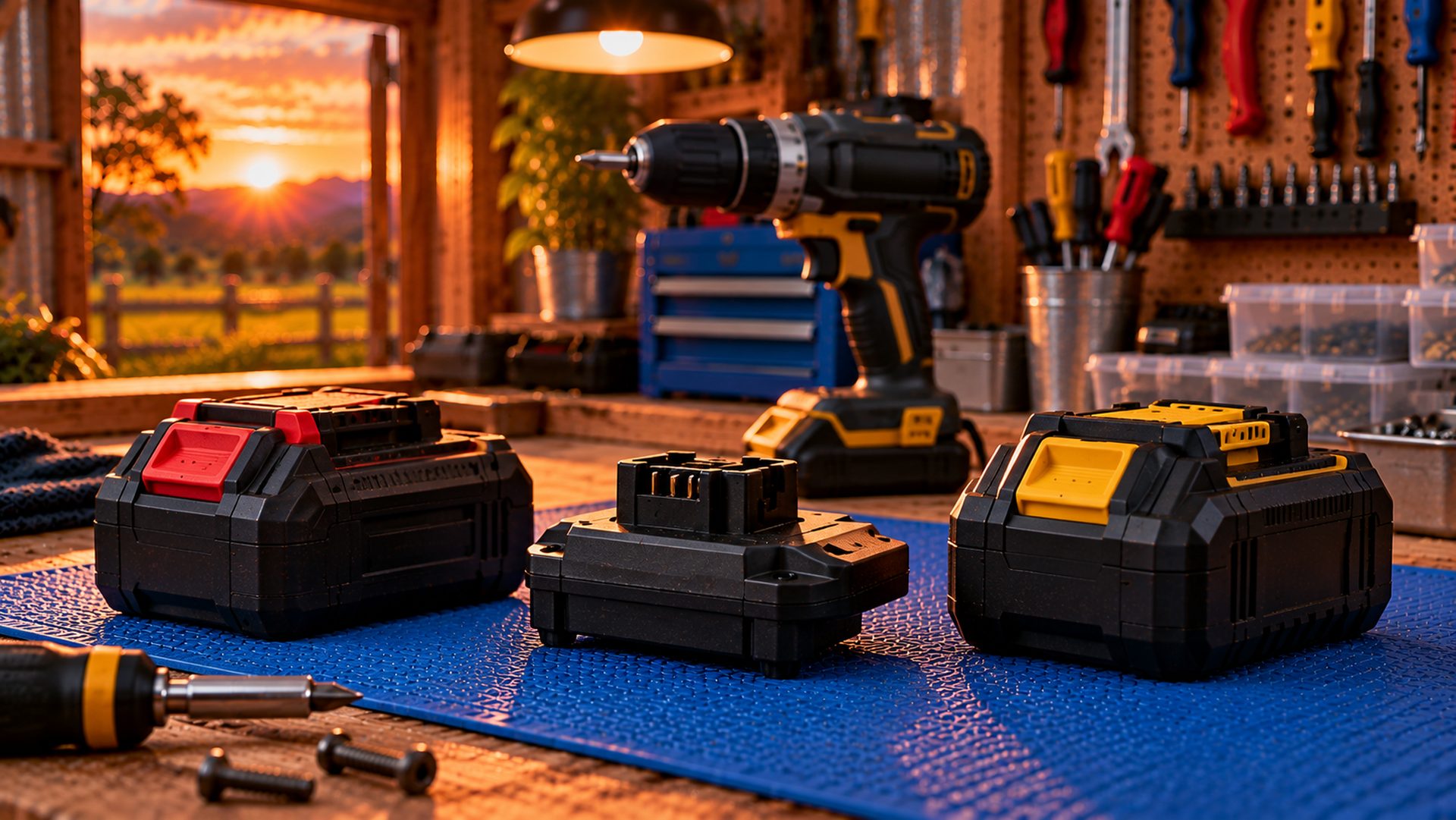
Battery Adapters Between Brands: Are They Safe?
How brand-to-brand battery adapters work, what can go wrong, and what to check before you use one.
Read guide →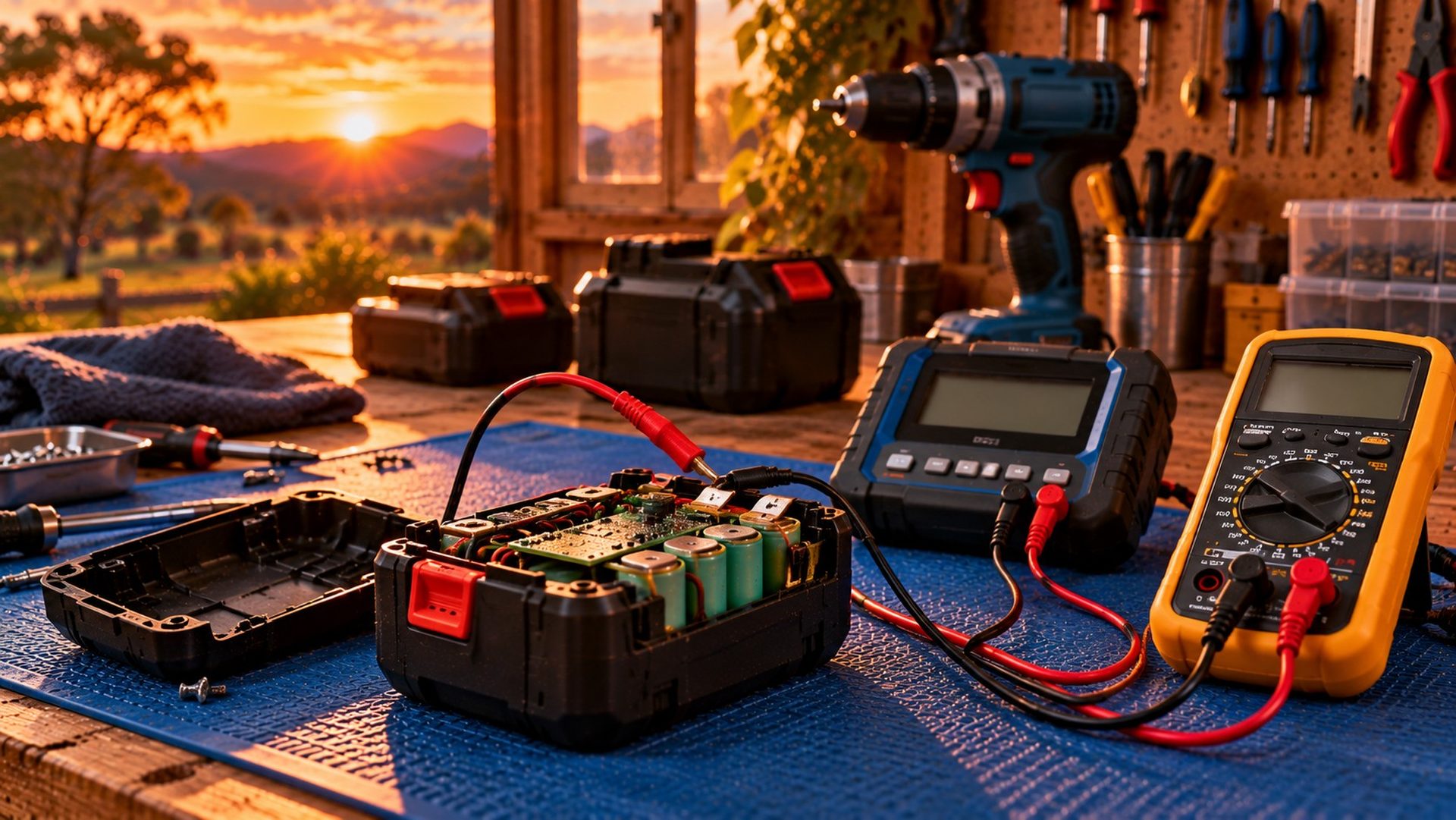
Is a Battery Pack Rebuild Worth It?
What's inside a tool pack, what a rebuild involves, and when it makes sense to rebuild, replace or recycle.
Read guide →