What Happens Inside a Lithium-Ion Tool Battery Pack?
Cells, the protection board and the sensors: how a tool pack works, explained without opening one.
A cordless tool battery looks like a plastic brick, but inside it's a small, carefully balanced system. Knowing what's in there helps you understand why packs behave the way they do: why they cut out, why chargers refuse them, and why opening one isn't a casual job.
You don't need to open a pack to learn this, and we don't recommend it. Opening a pack usually voids the warranty, and handling lithium cells safely takes the right knowledge and tools.
1. The cells
The energy is stored in cylindrical lithium-ion cells, usually 18650 or 21700 sizes. Each cell is about 3.6V nominal and about 4.2V when full. See 18650 vs 21700 Cells Explained.
2. Series and parallel groups
The cells are joined in two ways:
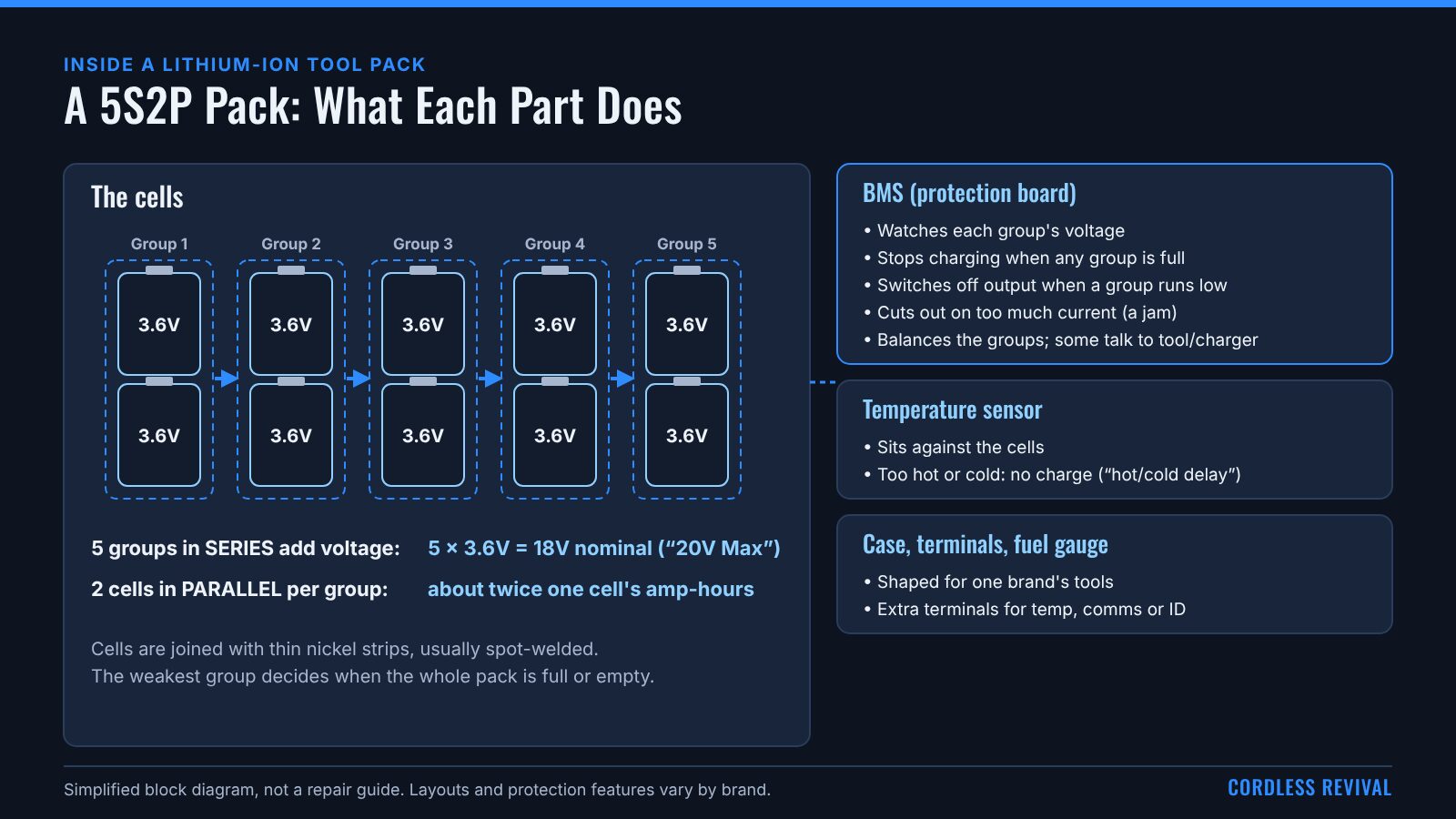
- In series (end to end) to build up the voltage. Five cells in series make an "18V" (or "20V Max") pack: 5 × 3.6V = 18V nominal.
- In parallel (side by side) to add capacity. Two rows of five cells make a pack with about twice the amp-hours.
That's what codes like 5S1P and 5S2P mean: 5 cells in Series, 1 or 2 in Parallel.
| Layout | Cells | Voltage | Capacity |
|---|---|---|---|
| 5S1P | 5 | 18V nominal | One cell's capacity |
| 5S2P | 10 | 18V nominal | Two cells' capacity |
The Cell Layout Calculator works out any layout.
Each group of cells in parallel acts like one bigger cell. The pack's protection watches each series group, because the weakest group decides when the whole pack is full or empty.
2a. Layouts worked through
Illustrative cell figures, not a real cell: each cell is 3.6V nominal and 2.5Ah.
| Layout | Cells | Voltage | Capacity | Energy |
|---|---|---|---|---|
| 5S1P | 5 | 5 × 3.6 = 18V | 2.5Ah | 18 × 2.5 = 45Wh |
| 5S2P | 10 | 18V | 2 × 2.5 = 5.0Ah | 18 × 5.0 = 90Wh |
| 10S2P | 20 | 10 × 3.6 = 36V | 5.0Ah | 36 × 5.0 = 180Wh |
Bigger cells, fewer of them: with an illustrative larger cell of 4.0Ah, a 5S1P pack gives 18 × 4.0 = 72Wh from just 5 cells. That's why 21700 cells allow compact, high-capacity packs.
2b. The weakest group decides
The pack is only as good as its weakest series group.
Example (illustrative): a 5S2P pack has five groups. Four still hold their full 5.0Ah, but one has aged and holds only 4.0Ah.
- On discharge, that weak group runs low first, and the protection switches the pack off. The pack behaves like a 4.0Ah pack, about 80% of new, even though the other four groups still hold charge.
- On charge, the pack may also stop charging early when that group reaches full first.
This is why one tired group can cost a lot of runtime, and why a voltage reading across the whole pack can't show it.
3. The connections
The cells are joined with thin nickel strips, usually spot-welded to the cell ends. Welding is quick and puts very little heat into the cell, which matters because heat damages lithium cells. See Spot Welder vs Soldering for Battery Packs.
4. The battery management system (BMS)
Most tool packs have a small circuit board, the BMS or protection board. Depending on the design, it may:
- Watch each series group's voltage, and stop charging when any group is full.
- Switch off the output when any group runs too low.
- Cut out on too much current, such as when a tool jams.
- Stop charging or use when the pack's too hot or cold.
- Balance the groups so they stay at similar charge levels.
- Talk to the tool and charger, on some brands, sharing temperature, charge state or a pack ID.
Not every brand puts all of this in the pack. Some systems share the job, with part of the protection in the tool or the charger. That's one reason a pack can behave differently in another brand's tool through an adapter. See Battery Adapters Between Brands.
4a. Cell vs pack
| A single cell | A tool pack | |
|---|---|---|
| Voltage | About 3.6V nominal, about 4.2V full | Set by cells in series (18V for 5S) |
| Capacity | One cell's Ah | Set by cells in parallel |
| Protection | Little or none of its own | A BMS, plus the tool's and charger's protection |
| Temperature sensing | None | A sensor near the cells |
| Connection | Bare cell ends | Shaped terminals, latch and data contacts |
| Safe handling | Needs knowledge and the right tools | Designed to be handled by anyone, as the maker intends |
5. Temperature sensing
Most packs carry a temperature sensor, often a small thermistor, sitting against the cells. The charger or tool reads it and:
- won't charge a pack that's too hot or too cold, which is the "hot/cold delay" light on many chargers
- may slow down or stop the tool if the pack overheats under heavy use
That's why a pack straight off a hard-working mower or saw often won't charge straight away.
6. The case, terminals and fuel gauge
- Terminals: the main power terminals, plus smaller ones on many brands for temperature, communication or ID.
- Fuel gauge: the button-and-lights display on many packs, reading the pack's state of charge.
- Case: holds and protects the cells, and is shaped for one brand's tools. Some packs have vents or internal supports to help with heat and shock.
6a. Why high-output packs exist
Some packs are built for hungry tools such as saws, grinders and mowers. They typically use larger or higher-current cells, or more cells in parallel. Either way, each cell carries less of the load, so the pack runs cooler and sags less under heavy current. That's why a high-output pack can suit a saw better than a compact pack of the same voltage.
7. How it all works together
Charging: the charger checks the pack's temperature and voltage. If they're in range, it charges, usually fast at first, then slowing as the cells approach full. The BMS stops the charge if any group gets too high or too hot.
Using it: the tool draws current from all the cells together. The BMS (and sometimes the tool) cuts out if the current's too high, the pack's too hot, or any group runs too low.
Storing it: cells slowly lose charge, and the BMS itself draws a tiny current. A pack left flat for months can drift below the point where the charger will accept it.
8. Why this matters to you
- Cut-outs aren't always faults. They're often the protection doing its job.
- One weak cell group limits the whole pack.
- Heat is the enemy, which is why packs have sensors and chargers wait.
- The protection is part of the design. Never bypass or remove it.
- Opening a pack is a job for someone with the right expertise. Hidden damage from a careless repair can cause a fire later.
9. Glossary
| Term | Meaning |
|---|---|
| Cell | One lithium-ion unit, such as an 18650 or 21700 |
| S (series) | Cells end to end; adds voltage |
| P (parallel) | Cells side by side; adds capacity |
| Group | Cells in parallel that act as one bigger cell |
| BMS | Battery management system: the protection board |
| Balancing | Keeping the groups at similar charge |
| Thermistor | A small temperature sensor |
| Nickel strip | Thin metal links joining cells, usually spot-welded |
| Cut-off | The point where protection switches the pack off |
10. Myths
| Myth | What's actually true |
|---|---|
| "A pack is just a big battery." | It's several cells plus protection and sensing, working as a system. |
| "Bigger Ah always means a better pack." | It means more capacity. High-output packs also matter for hungry tools. |
| "If it reads 20V it's fine inside." | One weak group can hide behind the others. |
| "The BMS makes any pack safe." | It's a protection layer. Damage, heat and modifications can still make a pack unsafe. |
11. Frequently asked questions
How many cells are in an 18V pack?
Usually 5 in series, times however many rows in parallel: 5, 10 or 15 cells, for example.
Why does my pack get warm when I use it?
Current flowing through the cells and connections makes heat. Very hot packs trigger the protection.
What does the BMS actually do?
It watches the groups' voltages, current and temperature, switches off when they go out of range, and on some packs balances the groups and talks to the tool and charger.
Can I replace one weak cell?
That means opening the pack and handling cells, which voids the warranty and needs the right expertise. See Is a Battery Pack Rebuild Worth It?. Cordless Revival doesn't repair packs.
Are 21700 packs better than 18650 packs?
They hold more per cell and often handle higher current, which allows compact, high-capacity packs. See 18650 vs 21700 Cells Explained.
Safety: this guide is general information. Don't open, rebuild or modify lithium packs without the right expertise. If a pack is swollen, hot, damaged or leaking, stop using it and see Lithium Battery Storage and Disposal. Cordless Revival doesn't repair or sell batteries.
Related guides
Battery Adapters Between Brands: Are They Safe?
How brand-to-brand battery adapters work, what can go wrong, and what to check before you use one.
Read guide →
Is a Battery Pack Rebuild Worth It?
What's inside a tool pack, what a rebuild involves, and when it makes sense to rebuild, replace or recycle.
Read guide →